The State of Cheating in 2026
Rules are meant to be broken. That’s not a games problem, it’s a human one.

Why Games Break
You’re deep in the flow state, it’s the final play of the game, you see the enemy and they have their back to you, this is it, one shot and then the euphoria of the win. Boom, you’re dead — game over. The kill cam shows what you already knew. That play was impossible, the other player wasn’t better than you. They were cheating.
Nobody likes to lose, but there’s nothing worse than losing to a cheat. It’s not just a loss, it’s a betrayal. You signed up for a fair fight. You put in the hours, learned the mechanics, developed the skills. And someone else decided that the rules didn’t apply to them.
That’s the reason that Anybrain exists.
That feeling, the one that makes you want to throw your controller at the wall, press alt-F4, or maybe even uninstall the game, that’s not a security problem. It’s a trust problem. And when enough players feel it, the whole ecosystem starts to crumble.
Studios know the surface-level stats: cheating drives churn, reduces retention, floods support queues with complaints and false reports and angry Reddit threads. But the deeper damage is harder to quantify. It’s the slow degradation of the community that makes multiplayer games worth playing in the first place. The unspoken agreement that says: we’re all here to compete for real.
When cheating runs rampant, it doesn’t just ruin a match. It poisons the well.
And the well is bigger than most people realise. Recent industry research estimates the global cheating ecosystem, cheat subscriptions, boosting services, account sales, currency farming; the whole shadow economy sits somewhere around a median estimate of $8.5 billion. To put that in perspective: that’s larger than the entire esports industry. A single Chinese cheat developer, busted in 2021, had made $77 million selling hacks for just one game. This isn’t just a nuisance, it’s a whole underground industry of its own.
“The whole shadow economy sits somewhere around a median estimate of $8.5 billion. To put that in perspective: that’s larger than the entire esports industry.”
Why we cheat
Before we talk about solutions, we need to understand the problem. And that means understanding cheaters as people, not just accounts to be penalized.
You can ban people but that doesn’t always stop people from cheating, to be effective it’s also good to understand why people cheat. That sounds obvious, but it’s actually a bit nuanced in the industry. Most anti-cheat companies talk about cheaters like they’re malware; fraudsters, threats to the ecosystem, a problem to be detected and eliminated. And fair enough, that is the job. But somewhere along the way, the conversation stopped being about players and started being about signatures, kernel access, and detection rates. At Anybrain, we’ve been building tech around HCI (Human computer interaction) and security since 2016. And honestly? We also fall into that trap. It’s easy to get so deep into the security layer that you forget there are actual humans on both sides. The players getting their games ruined, and yes, the people doing the ruining.
Zooming out, the uncomfortable truth is simply that cheating works. That’s why there’s a ghost industry. This isn’t even a game problem, it’s deeper than that. The short version is that cheats give our brains the shortcut to the reward without the grind. And in a world where games and tech are increasingly designed around progression, prestige, and status, that shortcut is genuinely tempting. The thrill isn’t always in the learning. Sometimes it’s just in winning, and in feeling powerful.
Games are social systems, but they’re also fantasies. We play them to escape, to feel powerful, to be someone we’re not in everyday life.
When a game sells you a power fantasy and then asks you to grind for hundreds of hours to achieve it, is it really surprising that some players look for the easy path?
Our brains love shortcuts and in some ways, cheaters are just following their natural wiring.
That doesn’t make it okay. But it does mean this isn’t a simple story of good players versus bad players. The motivations are ultimately human: the desire to win, to matter, to flex status in a world where you can control the outcome. Of course, there’s some cheaters who are malicious griefers who get off on ruining other people’s fun. Some are bored and curious. Some just want to see what happens when they break the rules. And some are so deep in rationalising their behavior, that they’ve convinced themselves everyone else is cheating too, so why shouldn’t they?
Not all cheating is created equal, either. Some are accepted and even lauded, speedrunners, for instance, exploit bugs and glitches and have built entire careers and communities around it. Modders push boundaries that eventually become official features. Game developers have god mode access to their own creations, in a way the original cheat code. The line between exploit and innovation has always been quite blurry.
None of that means cheaters should roam free and ruin the experience for everyone else. But treating every cheater as identical: same motivation, same intent, same punishment, ignores the complexity of the situation. And if we don’t understand the problem clearly, we’re going to keep building incomplete solutions. Just to be clear, we don’t have an answer to this either, but do believe that understanding the problem helps to better combat it.
The arms race
The games industry has been fighting cheaters for decades. And for most of that time, the approach has been the same: find the cheat software, block it, ban the player.
Traditional anti-cheat works like an antivirus software. It maintains a database of known threats: signatures, file hashes, memory patterns and scans for matches. When it finds one, it issues a flag or a ban. This worked for a time but things are changing. The problem is that cheat developers update their tools constantly. Every detection triggers a new version. Every patch gets reverse-engineered. The defender is always one step behind, reacting to what already happened instead of anticipating what’s coming.
This is the cat-and-mouse game the industry has been stuck with since its conception. And honestly? It’s exhausting for everyone involved.
Because of that some anti-cheat solutions go deeper — kernel-level access, rootkit-style monitoring, aggressive system scanning. These catch more cheats, but they come with real issues like privacy concerns, performance overhead, and false positives that ban innocent players with unusual hardware setups, VPNs, or just plain bad luck. Every wrongful ban is a support ticket, a refund request, a frustrated player who tells their friends, and now pretty much the whole world that the game punished them for nothing. The collateral damage adds up.
Meanwhile, the most sophisticated cheats, the ones built by people who actually know what they’re doing, the $200-a-month “undetectable” subscriptions with automatic updates are monetarily incentivised to find ways around even the most invasive detection. That’s people’s genuine livelihood on the line. So this arms race never ends. It just escalates.
There’s a structural reason for this. Signature-based detection is fundamentally reactive. You can only block what you’ve already seen. And in a world where new cheats appear daily, where cheat-as-a-service subscriptions offer detection guarantees and same-day patches, that’s a losing position.
Our reasoning is that the frame is wrong. We’ve been asking the wrong question.
So what if we looked at the player instead?
Every player has a fingerprint. Not a literal one but a behavioural one. The way you move your mouse. The rhythm of your keystrokes. The micro-hesitations before you take a shot, the correction patterns after you miss, the subtle differences in how your inputs shift when you’re under pressure versus when you’re relaxed and confident.
These patterns are unique as a signature. And they are almost impossible to fake at scale.
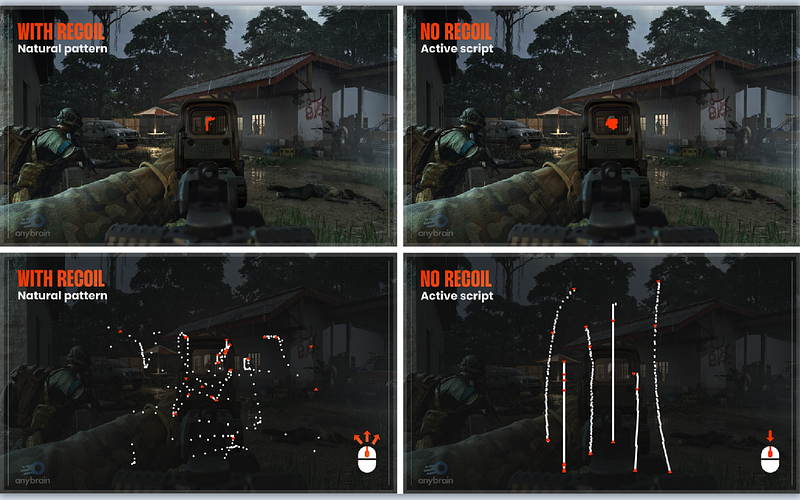
This is the insight that changes everything: a cheat can spoof a file, but it cannot replicate the ten thousand micro-decisions a human makes every minute of play. Think about it, what does an aimbot actually do? It removes hesitation. It eliminates overcorrection. It produces mechanical precision where there should be human imperfection, that wobble, the delay, the slight overshoot and recovery that real movements always have. And that imperfection, is exactly what makes genuine play identifiable.
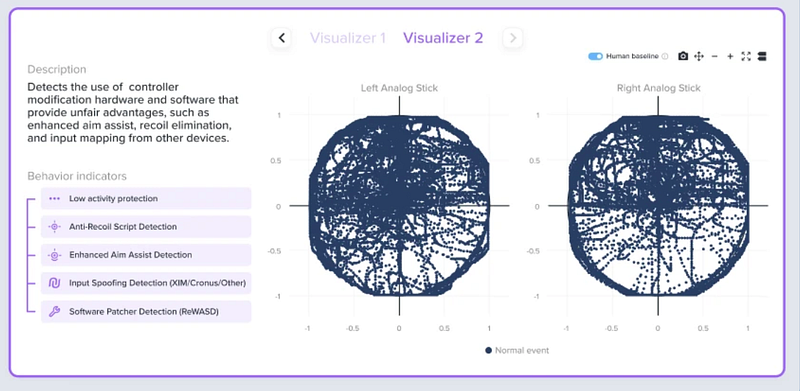
The tell isn’t the cheat software. The tell is the absence of humanity in the inputs. When you look at behaviour instead of code, you’re not asking “does this player have cheat software installed?”
You’re asking “does this player move like a human?” Those are different questions with very different implications. And the second one is much, much harder to fool.
It works across the board, too. A smurf account plays differently than the player’s main, the skill is there but the behavioural fingerprint doesn’t match the account history. A boosted account plays differently than its owner. A bot farms with repetitive consistency that no human can match over hours of play. Hardware modifications like Cronus or XIM alter the input signal in specific, learnable ways that separate them from a genuine human control.
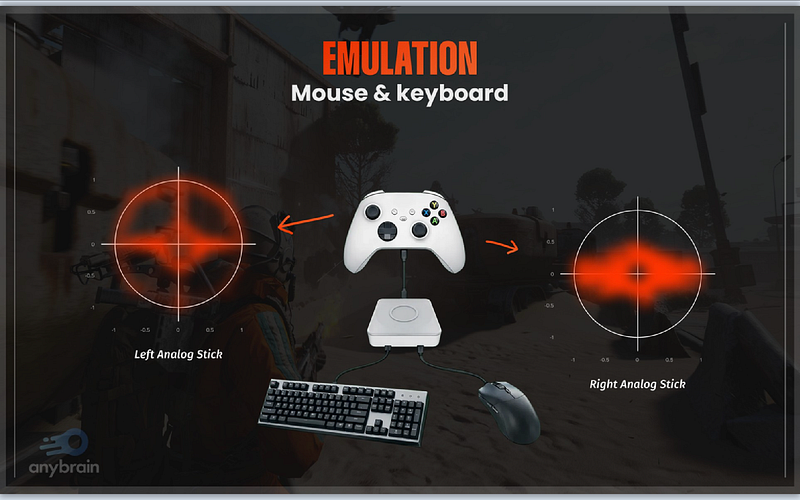
The fingerprint doesn’t lie, even when the credentials do.
Redefining the game we play
The question for studios has never really been “how do we catch cheaters?” It’s always been “how do we protect the experiences we’ve built?”
Those are different questions with different answers. One leads you to a ban list and an endless game of whack-a-mole. The other leads you to understand your players — who they are, how they move, when they’re thriving and when they’re about to leave.
That’s the game worth playing. And it starts with a simple shift in perspective.
Stop looking at the software. Start looking at the human.
The same creativity that makes games fascinating is exactly what makes them exploitable. We’ve spent enough time chasing code. It’s time to understand behaviour.
Traditional anti-cheat looks at software.
Anybrain looks at behaviour.
Cheats can hide in code.
But behaviour doesn’t lie.