
Anybrain Whitepaper: The Rise of Cheating As A Service
We’re seeing cheating change from something individual players did for an edge into a professionalised economy in its own right. The tools available to cheaters now, from generative AI to dedicated hardware, have raised the bar for what a cheat can do. Read the full report now.


The Cheating Problem in 2026 and How Developers are Taking Action
“We’re seeing cheating change from something individual players did for an edge into a professionalised economy in its own right. The tools available to cheaters now, from generative AI to dedicated hardware, have raised the bar for what a cheat can do, and that’s forced studios to rethink how they approach protection entirely.” - Andre Pimenta, CEO & Co-Founder of Anybrain
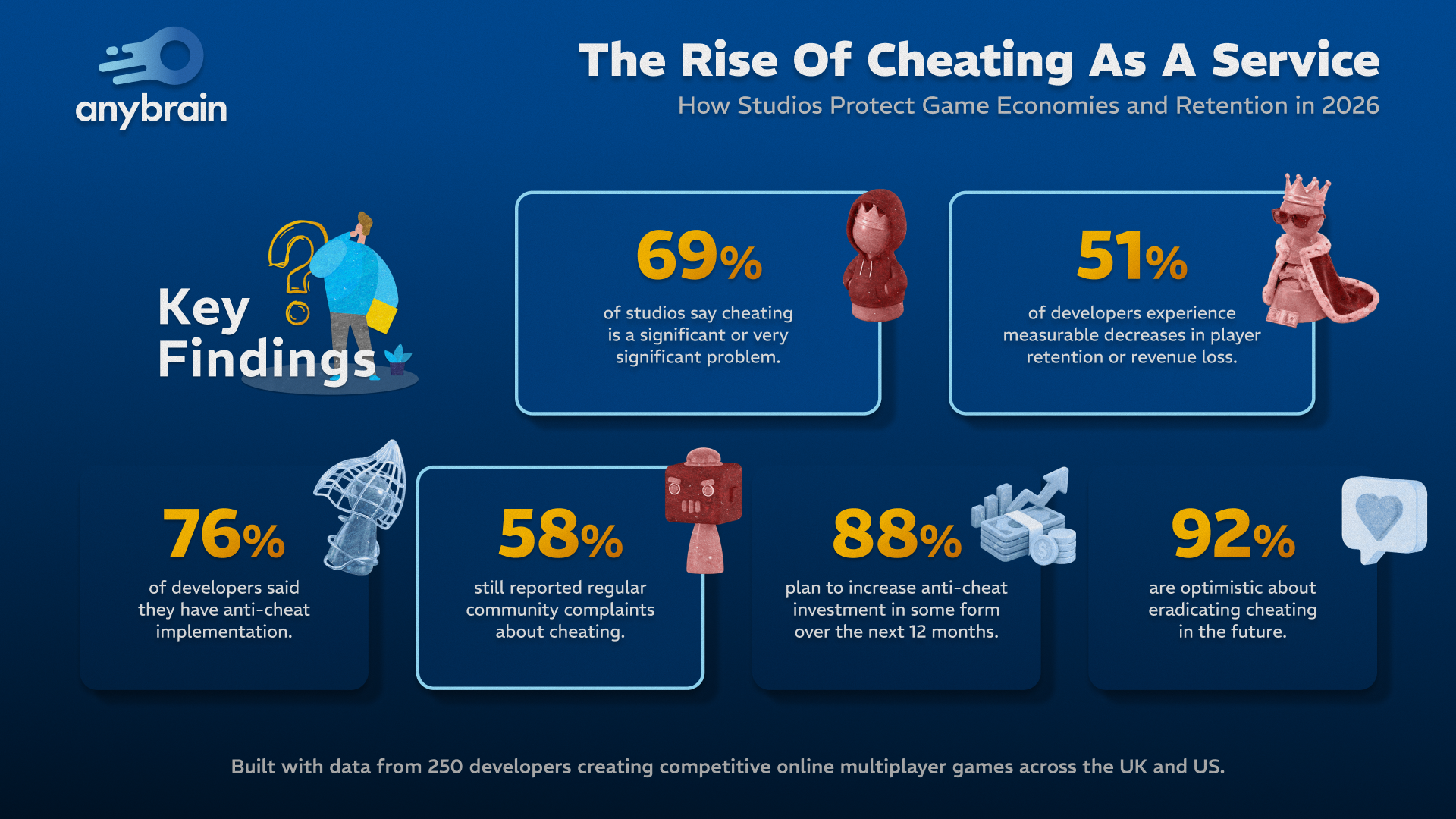
69% of developers now call cheating a significant or very significant problem in their games. Cheaters are like cockroaches. They’re incredibly resourceful, and now with AI, they are also more dangerous.
This isn’t a story of a few bad actors anymore. Cheating has become a structured, professionalized economy worth an estimated $8.5 billion globally, with Gen AI accelerating the speed at which new cheats reach the market.
This shift is reshaping how studios approach security, budget, and player trust, including their use of anti-cheat technologies, which are now a standard practice for 76% of developers.
This report on one of gaming’s oldest problems, breaks down where cheating is hitting the hardest, how studios are responding, and what it means for your security strategy for 2026 and beyond.
Inside the report
- Scale and impact: Data on how cheating affects retention, revenue, and community sentiment — based on 250 studios from the US and UK who are building competitive multiplayer games.
- Adoption and investment: How developers are allocating budgets, building dedicated anti-cheat teams, and stacking multiple solutions to solve their cheating problem, with 88% planning to increase investment over the next year.
- The evolving threat: A breakdown of how Gen AI, hardware exploits, and cheat-as-a-service platforms are changing what studios are up against.
- Why studios opt out: A look at the 24% of developers without any anti-cheat: their reasons, their risk tolerance, and why 73% say they’re planning to change that within the next year.
Who is this report for?
This report is built for executives and the teams responsible for player trust, security, and platform integrity in competitive multiplayer gaming, especially:
- Studio leadership and founders deciding how much to invest in security and anti-cheat infrastructure
- Live ops, community, and player experience teams managing the impact of cheating on engagement and sentiment
- Security, anti-cheat, and platform integrity teams benchmarking their approach against the wider industry
- Product and monetization teams assessing how cheating affects retention, revenue, and lifetime value
- Investors and corporate strategy teams evaluating game/platform security as part of due diligence
- Platform and publishing partners setting anti-cheat policy for potential partners or titles on their storefronts
Sneak Preview
Here’s a preview of what you’ll find inside the report:
About Anybrain
This free report is brought to you by Anybrain. Anybrain was built by combining a decade’s worth of AI and HCI research with our passion for online gaming. We have one clear mission: to protect fair and equitable play for all.
Traditional anti-cheat looks at software. Anybrain looks at behaviour. Cheats can hide in code. But behaviour doesn’t lie.
For more information on the Anybrain platform and our proprietary technology contact us now.