
The Security Stack for Game Development

The job of a game dev cannot be easy and cannot be seen as so. A game dev despite working in the videogames industry in its most important job (the making of games) and despite having the ability to build fantastic and everlasting games, a game dev has to surpass so many difficulties while creating a game. The numerous bugs and errors throughout the game, the first idea for the game that can change throughout the development process, and most certainly dealing with frustration and the stress of wanting to create something beautiful and with excellent playability. In the mix of all these worries, the game dev has to build a security stack that will protect the game that they are creating so that all of the work put into it can be appreciated by all the gamers.
So, let’s think about what a game dev needs to put in place to build that security stack so that they can prevent attacks from hackers and other cybercriminals on their game and the people that will play the game. There are numerous threats such as:
Threats to Video Game Security:
Video games face a variety of security threats, including cheating, hacking, and DDoS attacks. Cheaters are the act of a player actively using a method to gain advantage beyond normal gameplay, to beat adversaries or to make the game more easily; hacking can come in different ways as it is when a person overpasses the security of a network, computer or server with malicious intent (most of the times) and DDoS attacks (disturbed denial of service) is a cyber attack in which the perpetrator seeks to make a machine or network resource unavailable to its intended users by attacking from multiple remote locations with the flood of internet traffic. According to a report by Akamai Technologies, the gaming industry is the third most targeted by DDoS attacks (https://www.akamai.com/newsroom/press-release/akamai-research-shows-attacks-on-gaming-companies-more-than-doubled-over-past-year), with 12% of all attacks targeting gaming companies.
Anti-Cheat Solutions
Anti-cheat solutions are critical for preventing cheating and keeping players on the same and fair level of chance of winning. These solutions use client-side and server-side detection methods to detect cheats and prevent them from being used, ensuring a level playing field for all players.
Client-side detection methods typically involve scanning the user’s computer for any signs of cheating software or modifications to the game files. Server-side detection methods involve monitoring gameplay and network traffic for any signs of cheating.
Anti-cheat solutions are constantly evolving to keep up with new cheating methods and techniques. Some anti-cheat solutions also include machine learning and artificial intelligence to detect cheats and adapt to new threats, such as the case of Anybrain.
In this area, we can also talk about chat moderation and its implications to the security stack: not being a technical issue per se, a chat with good moderation tools will help in the security of the gamers inside the game, will help the gamers feel more comfortable and that they can communicate with others without the fear of harassment or even to being subjected to inappropriate content.
Game Server Authority
This particular part of the security stack is very important to online gaming. The server is responsible for the management of game sessions and communicating data between players. An authority server is defined as a setup where the user sends information that will be validated by the server and with this it will update the client accordingly. To simplify, this feature will allow the video game to protect itself with automated mechanisms against various threats.
Encrypted Data Storage
Encrypting data storage is crucial for protecting sensitive information such as player data, passwords, and payment information. Popular encrypted data storage solutions include Amazon AWS, Google Cloud Storage, and Microsoft Azure. By implementing encrypted data storage, game developers can ensure that data is stored securely and cannot be accessed by unauthorized users.
Encryption involves converting data into a format that cannot be easily read or understood without a decryption key. This ensures that even if data is stolen, it cannot be easily accessed by hackers. Encrypted data storage solutions also include access controls and logging to track who has accessed data and when.
Two-Factor Authentication
Two-factor authentication (2FA) is a critical security measure that adds protection to player accounts. 2FA requires users to provide two forms of authentication before accessing their accounts, such as a password and a code sent to their phone. Popular 2FA solutions include Google Authenticator, Authy, and Duo Security.
2FA prevents unauthorized access to player accounts even if a hacker has obtained the user’s password. This is because the hacker would also need access to the user’s phone or another authentication device in order to log in. Game developers can encourage players to use 2FA by offering incentives such as in-game rewards or special features.
Regular Updates and Patches
Regular updates and patches are critical for maintaining the security of video games. Game developers should regularly release updates and patches to fix security vulnerabilities and bugs that could be exploited by hackers. Players should be encouraged to install updates and patches as soon as they are released to ensure that their game is protected against the latest threats.
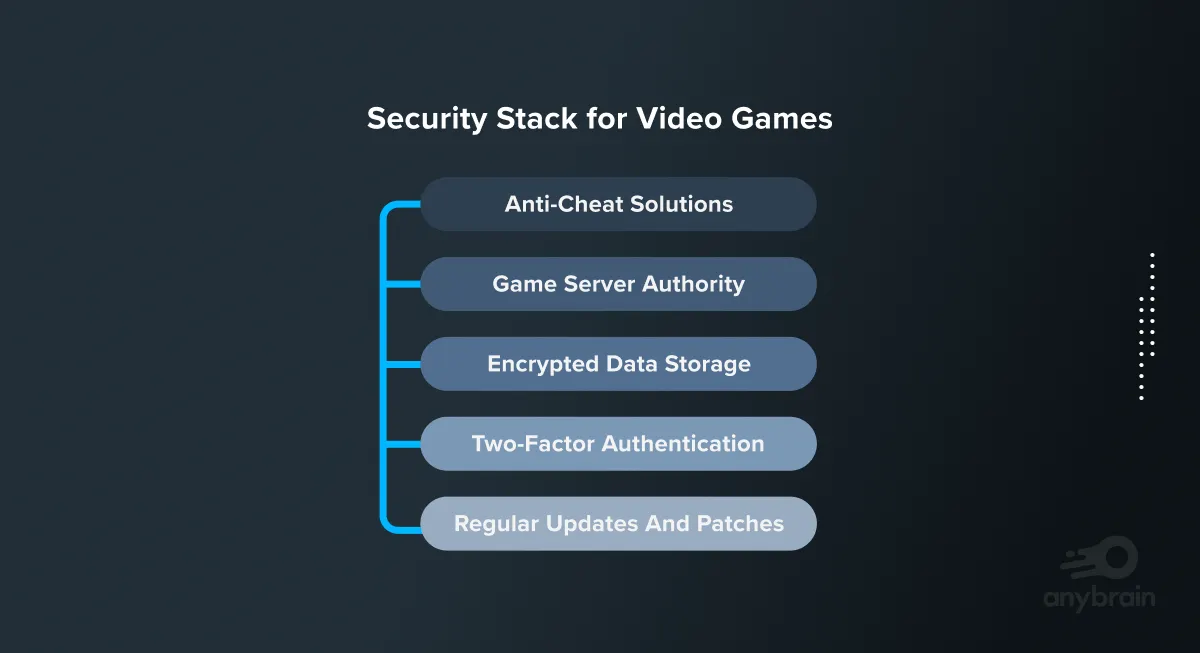
In conclusion, building a strong security stack for video games is essential to protect a game and its players from bad actors. By implementing anti-cheat solutions, game server authority, encrypted data storage, two-factor authentication, and regular updates and patches, game developers can ensure that their game is protected against a variety of security threats. After this, the game dev can then enjoy the outcome and grow a fully protected and strong community around their game, an awesome prize for someone who worked so hard.