
Productionizing Machine Learning Models
Part 2: Deployment Strategies

Turning Models into Real-World Solutions
Deploying machine learning (ML) models is crucial in turning your ideas into real-world solutions. While building the model itself is essential, making it work smoothly in a production environment comes with challenges. Your model must be reliable, scalable, and able to handle changing conditions without downtime.
This post will focus on the deployment phase — an essential part of the MLOps lifecycle. Choosing the right deployment strategy is not a one-size-fits-all decision. Your approach can significantly affect how well your system scales, how reliable it is, and how satisfied your users are. Whether you’re experimenting on a small scale or running large, enterprise-level models, it’s essential to understand the different deployment options.
This article builds on our previous post about getting ML models ready for production, where we covered the unique challenges of operationalizing machine learning. Today, we’ll dive into common model deployment strategies, their key features, benefits, and typical use cases.
Overview of Deployment Approaches
Selecting the right deployment strategy ensures a smooth transition from development to production. Below are the most common approaches, when to use them, and their pros and cons.
Shadow Deployment
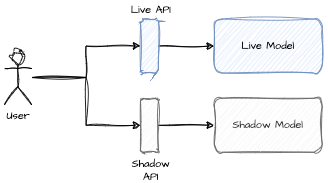
In shadow deployment, we can run a new model alongside your current model without affecting users. The live model handles requests while the latest model works in the background, allowing you to test performance safely.
Pros:
- No impact on the user experience.
- It is easy to compare performance with the live model.
- Reduces risk by keeping the new model separate.
Cons:
- Resource-intensive, as two models run at once.
- No direct user feedback on the shadow model’s predictions.
Best for: Safely testing new models in real-world conditions without user exposure.
A/B Testing
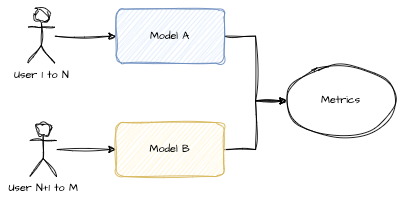
In this strategy, we split user traffic between two models to compare performance. Users see one model or another, and you measure metrics like accuracy or engagement to decide which is better.
Pros:
- Get real user feedback.
- It is ideal for user-focused applications like e-commerce or recommendation systems.
Cons:
- Requires a large user base for meaningful results.
- Sensitive to traffic variations and data quality.
Best for: Directly comparing two models to find the best performance.
Multi-Armed Bandit (MAB)
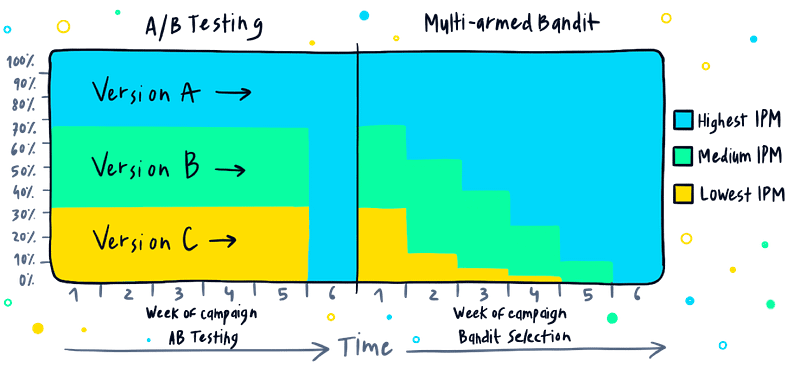
Inspired by reinforcement learning, this approach directs more traffic to better-performing models over time, automatically optimizing which model gets the most users.
Pros:
- Adapts quickly and efficiently to improve performance.
- Less resource waste compared to simple A/B testing.
Cons:
- It is computationally expensive and requires advanced monitoring.
Best for: High-traffic scenarios, such as dynamic pricing, where rapid optimization matters.
Blue-Green Deployment
In a blue-green deployment, we use two environments: one (blue) runs the current model, while the other (green) hosts the new model. After testing the green environment, you switch traffic over with minimal downtime.
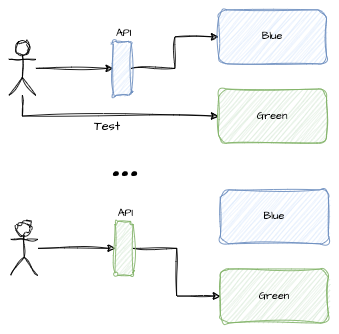
Pros:
- There is little to no downtime.
- Easy rollback if problems arise.
Cons:
- It can be costly due to duplicate infrastructure.
- Requires careful coordination between environments.
Best for: Systems where downtime is not acceptable.
Canary Deployment
In the canary deployment strategy, we introduce a new model to a small group of users. If it performs well, gradually increase the number of users who see it.
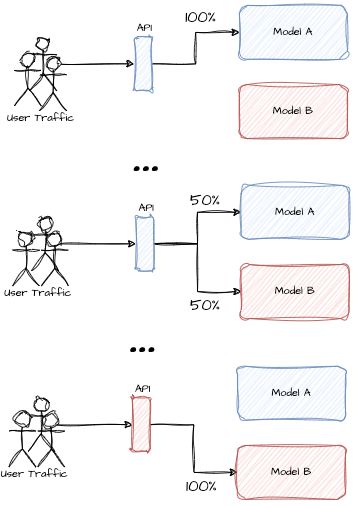
Pros:
- Real-world testing with low risk.
- Gradual rollout and easy rollback.
Cons:
- It needs strong monitoring to catch problems early.
- Slower rollout.
Best for: Situations where a careful, step-by-step release is essential, especially in consumer-facing apps.
Making the Right Choice
To deploy your machine learning models effectively, you must understand the various strategies available and when to apply them. Your choice will significantly influence your machine learning systems’ reliability, scalability, and overall performance in a production environment.
Consider the technical and business aspects when determining which deployment approach is best for your project. Each strategy has advantages and disadvantages, so the right choice will depend on model complexity, business objectives, and available resources.
Model Complexity: More complex models, such as those that rely on deep learning architectures or large-scale datasets, may benefit from strategies that allow safer testing before full rollout. For example, a shadow deployment can help validate complex models without disrupting the user experience, while a canary deployment can reveal performance issues at a manageable scale.
Business Requirements: Consider your tolerance for downtime or performance dips. If your application must remain constantly available, a blue-green deployment provides seamless transitions with minimal disruption. On the other hand, if your primary goal is to quickly gather user feedback, A/B testing or a multi-armed bandit approach might better align with your business objectives.
Resource Availability: Different strategies have different costs. Blue-green deployments, for instance, require parallel production environments, which increases infrastructure overhead. Shadow deployments, which run multiple models simultaneously, can be resource-heavy. Assess whether you have sufficient computing, storage, and budget before committing to a specific approach.
Risk Tolerance and Compliance: High-stakes applications — such as those in finance, healthcare, or critical infrastructure — often demand safer, more controlled rollout strategies. Shadow or canary deployments can mitigate risks by detecting issues early while preserving user trust and meeting regulatory requirements. If speed and innovation are top priorities, multi-armed bandit strategies can accelerate iteration but come with a higher operational risk.
By evaluating these factors, you can choose a deployment strategy that aligns with your technical capabilities, business objectives, and resource limitations. This thoughtful approach ensures that your selected method meets the requirements of your machine learning project and supports long-term success and growth.
Practical Guidance
Choosing the right deployment strategy is only the beginning. To achieve lasting success, it is crucial to implement effective practices for monitoring, maintenance, and continuous improvement.
Automate Wherever Possible: Implement Continuous Integration and Continuous Deployment (CI/CD) pipelines to streamline the model update process. Automated tests, performance checks, and validation steps can help catch issues early and maintain consistent quality.
Invest in Robust Monitoring and Alerting: Set up comprehensive monitoring to track key performance indicators like latency, error rates, and throughput. Real-time alerts can help your team quickly address problems as they arise, minimizing downtime and user impact. Logging and metrics tools can also provide insights into user behavior and model performance under different conditions.
Establish Clear Rollback and Recovery Procedures: No matter which strategy you choose, be prepared for the unexpected. Have a well-documented rollback plan that allows you to revert to a stable version if performance degrades quickly. A clear incident response process ensures smoother handling of unplanned outages or model failures.
Gather User Feedback and Iterate: Incorporate user feedback loops where possible. A/B testing and canary deployments can help you measure how changes affect user behavior for front-end applications. For back-end services, shadow deployments and monitoring tools can guide adjustments. Use these insights to refine models and enhance user satisfaction over time.
Start Small and Scale Up: To minimize risk and complexity, begin with limited rollouts. Test your chosen strategy on a subset of traffic or a single region before expanding to a full-scale deployment. Gradually scaling your approach helps validate assumptions, ensure stability, and identify scaling bottlenecks early.
Align Deployment Strategy with Business Goals: Regularly revisit your deployment approach to confirm it meets your organization’s evolving needs. As your traffic grows, your model’s complexity increases, or your business priorities shift, be ready to adjust your strategy. Flexibility ensures that your deployment methods continue to deliver the best possible results.
Aligning Deployment Strategies with Long-Term Success
Choosing the right deployment strategy is crucial in successfully operationalizing your machine learning models. Each approach — whether shadow testing, A/B testing, blue-green deployments, canary releases, or multi-armed bandits — has its strengths, limitations, and ideal use cases. You can select a method that best aligns with your organization’s goals by evaluating model complexity, business requirements, resource availability, and risk tolerance.
Once you have chosen a strategy, it’s essential to maintain strong operational practices such as effective automation, robust monitoring, and clear rollback procedures. Regular user feedback loops and iterative improvements help ensure that your deployment approach continues to support evolving business needs and technical demands.
However, there are still important questions that deserve deeper exploration:
- What metrics should be used to evaluate the performance of different deployment strategies?
- How can monitoring be effectively implemented during the various deployment strategies to ensure model performance and user experience?
These considerations will help refine your deployment workflows, ensuring that your models perform consistently and deliver value over the long term. In our next blog post, we’ll tackle these questions head-on, offering detailed guidance on metrics selection, monitoring best practices, and the essential tools and platforms that can streamline your ML deployment process. Stay tuned!